

Sailing the Cyclades over two weeks opens up extraordinary cruising options, but it also introduces real risk if the weather is underestimated or the itinerary is too rigid.
This guide is written for crews planning two-week charters from Lavrion, where distance, exposure, and the Meltemi wind must be factored into every decision. It is not a one-week extension and it is not suitable for first-time charterers without a skipper.
If you are coming to the Cyclades specifically to sail, cover miles, and explore further south, this article explains how experienced skippers actually plan those trips.
Start With the Only Question That Matters: What Will the Wind Do?
In summer, the Meltemi is not an occasional inconvenience. It is the defining system of the Aegean.
Across a two-week period in July or August, it is highly unlikely that you will experience:
- More than three or four consecutive calm days
- A full fortnight of gentle conditions
- Predictable wind strength from one week to the next
What is likely:
- Multiple days at 30+ knots
- One or two periods of 35–40 knots
- Being pinned in port for 24–48 hours at least once
Any skipper worth listening to plans two or three different routes before leaving the dock and commits to none of them until the first few days unfold.
This is not pessimism. It is seamanship.
Why Two-Week Cyclades Sailing Is Different From One-Week Sailing
With one-week cyclades sailing, you are managing comfort and return timing.
With two weeks, you are managing commitment and consequence.
Once you sail far enough south or east:
- Returning north becomes a strategic problem
- Beating into Meltemi seas is exhausting and often unsafe
- Motoring in 35–40 knots with crew aboard is rarely justified
Two weeks gives you opportunity, but only if you pace the trip conservatively and allow for weather-driven pauses.
The Four Core Cyclades Cruising Areas From Lavrion
Below are the four most realistic two-week Cyclades crusing directions, all starting from Lavrion. Each has its own character, rewards, and risks.
These are not exhaustive. They are the routes that experienced skippers repeatedly choose.
1. Western Cyclades Extension (Lavrion → Milos → Lavrion)
Best for: Steady pace, scenery, flexibility
Risk profile: Lowest
Time requirement: Ideal for two weeks
This is the most forgiving way to use a full fortnight in the Cyclades.
By extending the western route south beyond Sifnos to Milos, crews enjoy:
- Shorter legs
- Excellent shelter options
- Gradual southward progression
- Easy northbound return windows
Typical flow (weather-dependent)
- Lavrion → Kythnos → Serifos → Sifnos
- South to Milos and surrounding anchorages
- Slow return north via the same island chain
Milos alone can justify several days, with highlights such as Kleftiko, Poliegos, and protected south-coast anchorages.
For many experienced crews, this is the ideal two-week Cyclades cruise: enough distance to feel exploratory, without over-committing.
2. Eastern Cyclades Route (Paros, Naxos, Mykonos)
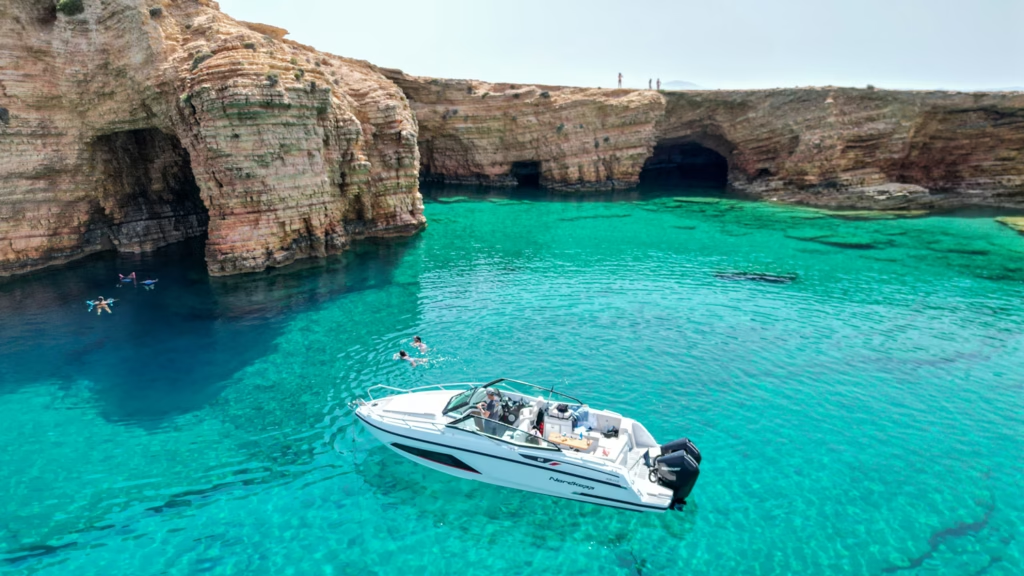
Odysseus – Nordkapp Noblesse 830 | Luxury Day Charter in Paros
Best for: Iconic islands, nightlife, culture
Risk profile: High
Time requirement: Two weeks minimum, plus patience
The eastern Cyclades are beautiful and popular, but they sit directly in Meltemi acceleration zones.
Key islands include:
- Paros
- Naxos
- Mykonos
These crossings are often:
- Gusty
- Short-steep seas
- Upwind on the return
This route is viable only if:
- You have schedule flexibility
- You are comfortable waiting several days
- You accept that plans may change mid-trip
It is common for boats to reach Paros or Naxos easily, then lose multiple days waiting for a safe return window.
3. Small Cyclades Loop (South of Naxos)
Best for: Remote charm, anchorages, swimming
Risk profile: Medium to high
Time requirement: Two weeks essential
The Small Cyclades, including Koufonisia, Schinoussa, and Iraklia, are often described as magical, and rightly so.
They offer:
- Clear water
- Minimal development
- Quiet anchorages
- A completely different pace
However:
- Shelter is limited
- Ports are small
- Weather windows matter
This route should only be attempted with:
- Strong anchoring confidence
- Conservative passage planning
- A willingness to wait out weather
It is not uncommon to spend several unplanned days stationary in this region.
4. Southern Cyclades Push (Folegandros & Beyond)
Best for: Dramatic landscapes, once-in-a-lifetime sailing
Risk profile: Highest
Time requirement: Two weeks minimum, preferably more
Reaching islands like Folegandros or even Santorini is often discussed casually, but the reality is serious.
Once you are this far south:
- Return timing dominates every decision
- Waiting becomes part of the itinerary
- Crew fatigue becomes a factor
This route is best reserved for:
- Very experienced crews
- Skippered charters
- Sailors who accept that plans may be abandoned
It is spectacular, but unforgiving.
A Realistic Two-Week Pacing Model
Experienced skippers often think in thirds:
- Days 1–4: Position south while conditions allow
- Days 5–10: Explore or wait, depending on weather
- Days 11–14: Conservative northbound return
If you invert this logic, problems arise.
Who This Style of Sailing Is For
These extended Cyclades sailing
routes are appropriate if:
- You have two full weeks
- You are comfortable changing plans
- Your crew understands waiting is normal
- You prioritise safety over ticking islands off a list
They are not appropriate for:
- Fixed one-week schedules
- First-time charterers without a skipper
- Crews uncomfortable in strong wind and swell
Final Advice: Distance Is Optional, Getting Home Is Not
The Cyclades reward ambition, but they punish overconfidence.
Two weeks gives you time, not immunity. The Meltemi will assert itself, and good sailing in this region comes from adapting early rather than pushing late.
If you plan conservatively, choose the right cruising area, and respect the wind, an extended Cyclades sailing can be extraordinary. If you plan rigidly, it can become exhausting very quickly.
Sail the forecast, not the map.